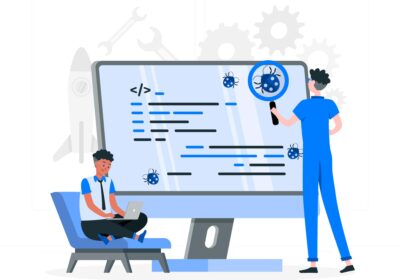
Code reviews used to be a team sport. Now, AI is the new team member, always available, relentlessly fast, and surprisingly good at spotting what humans miss.
In 2025, AI-powered static analysis and code review tools like CodeWhisperer, CodeQL, and CodiumAI aren’t just optional productivity hacks. They’re fast becoming standard tooling for high-velocity development and secure-by-default pipelines.
If you’re still treating code reviews as manual-only gatekeeping, you’re shipping slower, and possibly less securely, than your competitors.
The Review Bottleneck Is Real
Every developer has felt it:
- Pull requests sit idle for days.
- Reviewers skim and approve without context.
- Security issues and logic bugs slip through.
Meanwhile, engineering leaders push for faster releases, tighter SLAs, and fewer regressions. Manual reviews alone can’t scale to this reality.
That’s where AI comes in, not to replace human reviewers, but to augment, accelerate, and de-risk the process.
Meet the AI Review Stack
Here’s how modern teams are using AI to level up their pull request workflows:
CodeWhisperer (Amazon)
- Autocompletes and rewrites code with contextual understanding.
- Offers inline security scanning and compliance tips.
- Integrates into your IDE or PR toolchain.
CodeQL (GitHub)
- Performs semantic static analysis using code-as-data queries.
- Detects vulnerable patterns in custom code, not just dependencies.
- Used by open source and enterprise teams for critical path code.
CodiumAI
- Auto-generates test cases during PR creation.
- Suggests missing edge cases and corner conditions.
- Enhances test coverage and helps reviewers reason about logic.
These tools don’t just flag obvious bugs. They provide explainable, context-aware suggestions that help reviewers focus on architectural issues, not typos or boilerplate.
Why This Isn’t Just a Trend
- Security is now a PR concern
Shift-left has moved from slogan to standard. PRs are the best place to catch security flaws, before they go live. - Review latency kills dev velocity
AI reduces wait times and gives developers near-instant feedback, unblocking reviewers. - AI scales where humans can’t
Large orgs with dozens of services and thousands of PRs per week can’t rely on manual eyes alone. - Compliance requires traceability
Tools like CodeQL offer auditable trails of analysis, helping satisfy ISO, SOC2, or internal security frameworks.
How AI Code Review Works in a Real-World Workflow
- Dev opens a PR
- AI tools auto-run:
- Linting and formatting
- Static analysis (security, logic, performance)
- Test generation or validation
- Human reviewer sees a pre-filtered view:
- Warnings grouped by severity and area
- Suggested fixes pre-written
- Tests already generated or suggested
- Approval or changes requested, with AI support in context
This flow saves hours per week and raises review quality. In teams that deploy daily or hourly, it’s a game-changer.
But… Can You Trust the Machines?
AI code review isn’t perfect. False positives still happen. Some edge cases still require human judgment. But with proper governance:
- Use AI for first-pass reviews, not approvals.
- Combine with linters, SAST tools, and CI gates.
- Train your team to validate, not blindly accept, suggestions.
Over time, developers build intuition around what AI gets right, and where to double-check.
What Great AI-Augmented Reviews Look Like
- Speed: PRs reviewed in minutes, not hours.
- Depth: AI surfaces security issues and logic gaps early.
- Collaboration: AI handles the mundane; humans focus on architecture and design.
- Confidence: Teams merge with higher trust, fewer rollbacks.
How Verbat Helps Teams Build AI-First Code Workflows
At Verbat, we help software teams integrate AI into their SDLC, from pull request workflows to CI/CD automation. Our platform engineering approach ensures:
- Secure-by-default review automation
- Seamless integration of tools like CodeQL and Codium
- Developer training on prompt-driven review workflows
If you’re still reviewing code like it’s 2018, it’s time to level up. Want help designing AI-augmented workflows for your team? Let’s talk.